A guide to types of payment methods
A complete guide that lists the different types of payment methods available to help you understand and select the right payment options for your business.

Twenty years ago, "payment methods" mostly meant cash, check, or card. Today a checkout page might offer eight or more distinct options, and picking the wrong mix can quietly cost a business real revenue: customers abandon a purchase when their preferred way to pay isn't available. Here's a practical breakdown of what's actually out there, and how to think about which ones your business needs.
Why offering the right payment methods matters
Payment preferences vary enormously by region, generation, and purchase type. A business that only accepts one or two methods isn't just being simple, it's actively losing customers who expected a different option at checkout. Understanding what's available is the first step to building a checkout that doesn't quietly turn people away.
Credit and debit cards
Still the default for most online and in-person transactions in North America and much of Europe. Accepting cards requires a payment processor, a merchant account, and for anything online, a payment gateway to securely capture card details. Card-not-present transactions, like online or phone orders, typically require CVV verification as a baseline fraud prevention measure, and any business handling card data needs to maintain PCI compliance. For a full breakdown of getting set up, see our guide on how to accept credit card payments.
Bank transfers
Money moved directly between bank accounts, without a card network involved.
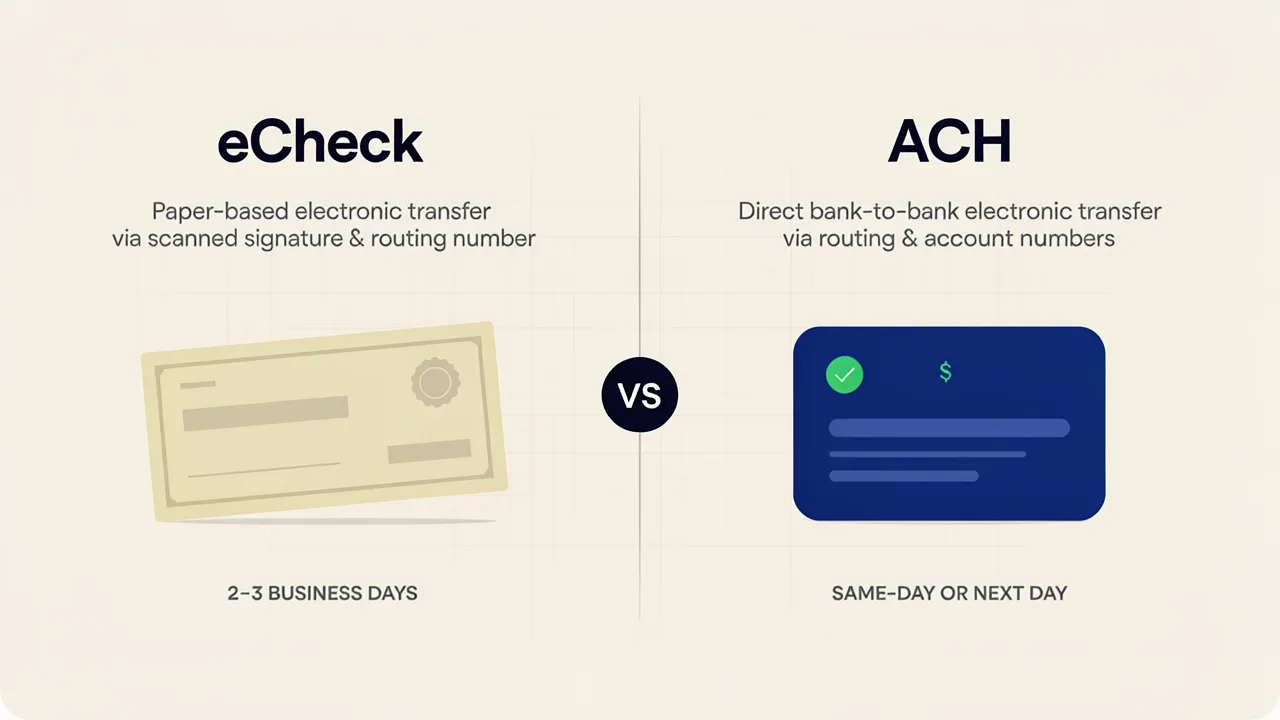
ACH transfers (US) move funds in batches, typically taking one to three business days, and cost significantly less than card processing, making them common for recurring billing and larger transactions.
Wire transfers move funds individually rather than in batches, arriving much faster, often the same business day domestically, but at a higher cost. See our full guide on what a bank wire transfer is and how it works.
International wire transfers require a SWIFT/BIC code to route funds to the correct bank abroad, and generally take longer than domestic transfers, typically 1 to 5 business days depending on the destination.
Digital wallets
Apps and services that store payment information and let users pay with a tap or a single click, rather than re-entering card details every time.
Apple Pay and Google Pay let customers pay using a card already stored on their phone, often with faster checkout and lower cart abandonment than manual card entry.
PayPal functions as both a digital wallet and a standalone payment method, widely recognized and trusted, especially for online marketplace transactions.
Buy now, pay later (BNPL) services like Klarna or Afterpay split a purchase into installments, increasingly popular for higher-ticket e-commerce purchases.
Cash and cash-equivalent methods
Still relevant for in-person businesses, and in some regions, essential for online commerce too.
Cash remains standard for many in-person transactions, particularly for smaller businesses and certain regions or demographics.
Cash vouchers allow customers without a bank account or card to pay for online purchases in cash at a physical retail location, common in markets with a large unbanked population.
Cryptocurrency
A smaller but growing segment, particularly for businesses serving tech-forward or international customers. Crypto payments can reduce cross-border transaction costs and settlement time, but come with price volatility and a different regulatory landscape than traditional payment methods, worth researching carefully before offering it as an option.
How to choose the right mix for your business
The right combination of payment methods depends heavily on your business type:
E-commerce and marketplaces generally need broad card support plus at least one digital wallet option, since checkout friction directly affects conversion rate. See processors built for ecommerce.
Subscription and SaaS businesses should prioritize reliable recurring billing support, typically cards or ACH, since failed recurring payments (involuntary churn) can quietly erode revenue. Compare subscription-focused processors.
Professional services and B2B businesses often see larger transaction sizes, where ACH or wire transfers make more sense than card fees eating into margin on a five-figure invoice.
International businesses need to research locally preferred methods per region rather than assuming card-first works everywhere; some markets strongly prefer bank-based or cash-voucher methods over cards. See our guide on international payments for more.
Final thoughts
There's no single "right" set of payment methods, the correct mix depends on your customers, your transaction sizes, and where you sell. What's consistent across every business type is that offering too few options costs real revenue at checkout, while the right mix reduces friction and builds trust with the specific customers you're trying to reach.
If you're evaluating which processor supports the payment methods your business actually needs, it's worth comparing providers side by side rather than assuming they all offer the same coverage.
More from the blog
What Is a Payment Processor? How It Works, Step by Step
A payment processor moves money between your customer’s bank and yours. Here’s how it works, how it differs from a gateway and merchant account, and what it costs.

20 Questions to Ask a Payment Processor Before You Sign
Don’t sign a processing agreement blind. Here are 20 questions to ask about fees, funding, contracts, security and support, plus what a good answer sounds like.
eCheck vs ACH: What’s the Difference and Which Should You Use?
If you’ve ever tried to set up bank payments for your business, you’ve probably hit this wall. One provider says “eCheck,” another says “ACH,” and you’re left wondering if you’re comparing two products or one product with two names.