eCheck vs ACH: What’s the Difference and Which Should You Use?
If you’ve ever tried to set up bank payments for your business, you’ve probably hit this wall. One provider says “eCheck,” another says “ACH,” and you’re left wondering if you’re comparing two products or one product with two names.
If you’ve ever tried to set up bank payments for your business, you’ve probably hit this wall. One provider says “eCheck,” another says “ACH,” and you’re left wondering if you’re comparing two products or one product with two names.
Good news: it’s mostly one idea. But the details matter when you’re choosing how to collect money, so let’s sort it out in plain English.
The short answer
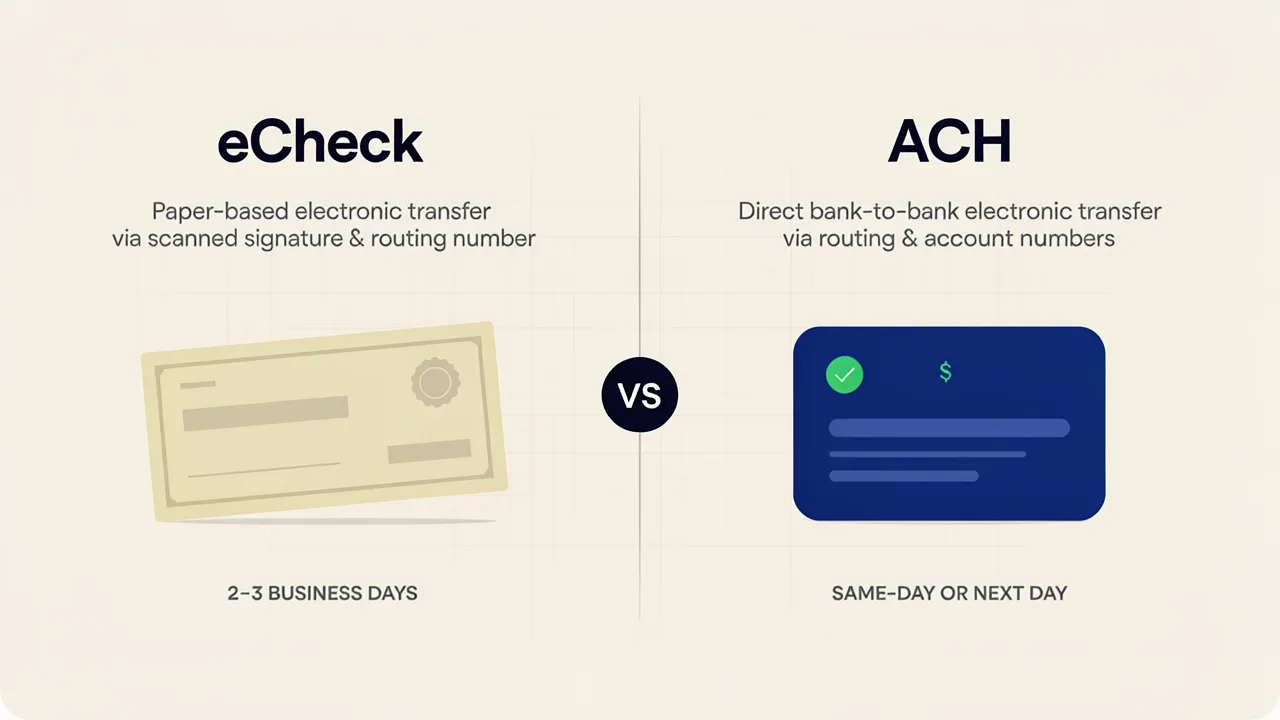
Every eCheck is an ACH payment. Not every ACH payment is an eCheck.
ACH is the network. It’s the system banks in the U.S. use to move money between accounts electronically. Direct deposit, bill pay and payroll all run on it.
An eCheck is a specific way of using that network. A customer gives you their bank details and permission to take a payment, usually through an online form, and the money moves from their checking account to yours. Think of it as a paper check with the paper removed.
So the real question isn’t “eCheck or ACH?” It’s “what kind of bank payment do I need, and who is starting it?”
How an eCheck payment works
The customer chooses to pay by bank account.
They enter their routing number and account number on a secure form.
They authorize you to debit the amount.
Your processor sends the request through the ACH network.
The customer’s bank approves or rejects the debit.
The funds settle into your business account.
Need help finding those numbers? Our guide to the ABA routing number walks customers through it.
What does it cost?
This is where bank payments usually win. Card payments involve card networks and issuing banks, and your fees reflect that. ACH moves over bank rails, so providers often charge a flat fee per transaction or a small percentage, and many cap it. For larger payments, that gap can add up fast.
Here’s a quick example. On a $2,000 invoice, a card rate of about 3% costs you $60. A bank payment with a small flat fee or low percentage could cost a fraction of that.
Pricing varies a lot by provider, so don’t trust a headline number. Plug your own volume into our processing fee calculator, and read how to lower your payment processing fees for more ways to cut costs.
How long does it take?
Slower than a card, and that’s the trade-off. Standard ACH commonly takes a few business days to settle. Authorize.net, for example, says eCheck processing typically takes three to five business days. Same-day ACH exists, but it depends on your provider and the cutoff times, and it may cost extra.
Weekends and bank holidays don’t count, so a payment started on Friday afternoon may not land until the following week.
If you need money right away, a wire is faster but pricier. See our guide to bank wire transfers for how they compare.
The risks to know about
Bank payments are cheaper, but they aren’t risk free.
Returns for insufficient funds. A payment can look fine at first, then bounce days later if the customer’s account is short.
Disputes. Customers can challenge debits they say they didn’t authorize, and consumers generally have a longer window to do this than most people expect. Keep your signed or recorded authorizations on file.
Typos. One wrong digit in an account number can delay a payment.
Fraud. Bank details are sensitive, so use a secure, compliant processor and review our guide on why payment security should be a priority.
If you’re curious how reversals work across payment types, read our explainer on payment reversals and how a chargeback differs from an ACH return.
When should you choose eCheck or ACH?
Choose eCheck when:
You send invoices of a few hundred dollars or more
Customers prefer to pay from a bank account
You want a lower-cost alternative to cards on big tickets
Choose recurring ACH when:
You bill for rent, memberships, retainers or subscriptions
You want fewer failed payments from expired cards
You collect the same amount on a schedule (see our subscriptions and SaaS processors)
Stick with cards when:
Customers expect instant confirmation
You sell small, impulse purchases
You want stronger buyer familiarity at checkout
Consider a wire when:
The payment is very large or urgent and speed matters more than cost
Most businesses don’t pick just one. They offer cards for convenience and bank payments for bigger or repeat charges. Our guide to types of payment methods shows how to build that mix.
How to start accepting bank payments
Pick a processor that supports ACH. Start with our list of ACH processors, or see how to choose a payment processor step by step.
Check the fees and settlement times before you sign up.
Set up clear customer authorization, including a plain-language checkbox or recorded consent.
Plan for returns. Decide how you’ll handle failed payments and what fees you’ll pass on.
Tell customers it’s an option. Many won’t know unless you show it.
For a broader look at where eChecks fit, read our posts on what an e-cheque is and how ACH payments work. If you want the wider picture of electronic transfers, our explainer on EFT is a good next stop.
Frequently asked questions
Is an eCheck the same as ACH?
Nearly. An eCheck is one kind of ACH payment, where a customer authorizes a debit from their checking account.
Are eChecks cheaper than credit cards?
Often, yes, especially on larger payments. Always confirm your provider’s actual fees.
How long does an eCheck take?
Usually a few business days, though same-day options exist with some providers.
Can I use eChecks for recurring billing?
Yes, as long as the customer authorizes repeat withdrawals. Bank accounts also don’t expire like cards do.
Can an eCheck bounce?
Yes. If the customer lacks funds, the payment can be returned after you thought it cleared.
The bottom line
eCheck and ACH are two names for closely related things. What matters is whether bank payments fit your business. If you bill larger amounts or repeat charges, they can save you real money. If you need instant confirmation, cards still win. Many businesses use both.
Ready to compare providers? Browse our full processor directory and find one that fits.
More from the blog

How to Decline a Venmo Payment: What Happens Next?
Venmo doesn’t offer a simple way to “decline” incoming payments, but that doesn’t mean you’re powerless.

Square Fees in 2026: Here's What You Should Know
Square fees in 2026 are 2.6% + 15 cents in-person, 2.9% + 30 cents online, and 3.5% + 15 cents keyed-in. See the full breakdown and when Square may cost more than alternatives.

Visa vs Mastercard (2026): Differences, Acceptance & Fees Explained
Visa and Mastercard play a major role in card payments. Learn how their networks affect card acceptance, processing, fees, and security for businesses.