What is an e-cheque, and how does it work?
Learn what e-cheques are, how they work, and how businesses can accept and process e-cheque payments.

An eCheck (electronic check) is a digital version of a paper check that moves funds directly between bank accounts through the ACH network, instead of a customer writing and mailing a physical check.
Paper checks have largely disappeared from everyday transactions, but the underlying idea, authorizing a direct transfer from a checking account, hasn't gone anywhere. It's just moved online, in the form of the eCheck.
How an eCheck works
An eCheck requires the same core information as a paper check: the payer's bank account number, routing number, and authorization to move funds. The difference is that this information is submitted electronically, usually through an online form, rather than written out by hand and mailed.
The typical process:
The customer provides their bank account and routing number, and authorizes the payment (often by checking a box or submitting a form)
The transaction is submitted through the ACH network, the same electronic system used for direct deposits and bill pay
The paying bank verifies the account and available funds
Funds transfer from the customer's account to the merchant's account, typically within 1 to 3 business days
Because eChecks run through the same ACH rails as other bank transfers, they're functionally a type of ACH payment, just framed around the "check" concept for merchants and customers used to that terminology.
eCheck vs. credit card payments
These are often compared because both are common online checkout options, but they work quite differently:
Processing cost. eChecks generally cost merchants significantly less per transaction than card processing, since there's no card network fee involved.
Speed. Credit card transactions settle faster (often next business day), while eChecks typically take 1 to 3 business days to fully clear.
Chargebacks. Card transactions carry chargeback risk through the card network's dispute process; eChecks have a different, ACH-specific return process (an eCheck can "bounce" similarly to a paper check if funds aren't available).
eCheck vs. wire transfer
Both move money bank-to-bank, but for different use cases. A wire transfer processes individually and arrives much faster, often same-day, but at a meaningfully higher cost per transaction. eChecks process in batches through ACH, taking longer but costing far less, which makes them better suited to routine, lower-value, or recurring payments rather than urgent, high-value transfers.
Why businesses use eChecks
Lower processing costs. For recurring or larger transactions, the cost savings versus card processing fees can add up meaningfully over time.
Recurring billing reliability. Bank account numbers change far less frequently than card numbers (which get reissued after loss, theft, or expiration), making eChecks a stable option for subscription businesses trying to reduce failed recurring payments.
Lower chargeback exposure. eChecks don't carry the same chargeback dispute process as card payments, which some merchants view as a meaningful risk reduction, provided proper authorization is documented.
What businesses need to accept eChecks
Accepting eChecks requires:
An ACH-enabled merchant account or a payment processor that supports ACH transactions
A method for capturing customer authorization, since ACH debits legally require documented consent
Bank account verification, to reduce the risk of processing a payment against an invalid or closed account
Most modern payment gateways support eCheck/ACH processing alongside card payments, so it's often a matter of enabling the option rather than building a separate integration.
Final thoughts
An eCheck is simply a paper check's function, moving money directly from a customer's bank account, translated into an electronic ACH transaction. For businesses handling recurring billing or larger transactions where card fees eat into margin, it's often a lower-cost complement to card payments rather than a replacement for them.
For a broader look at how eChecks fit alongside cards, wire transfers, and digital wallets, see our complete guide to payment methods.
Evaluating which processor best supports ACH and eCheck payments for your business? Compare providers side by side on cost and features.
More from the blog
What Is a Payment Processor? How It Works, Step by Step
A payment processor moves money between your customer’s bank and yours. Here’s how it works, how it differs from a gateway and merchant account, and what it costs.

20 Questions to Ask a Payment Processor Before You Sign
Don’t sign a processing agreement blind. Here are 20 questions to ask about fees, funding, contracts, security and support, plus what a good answer sounds like.
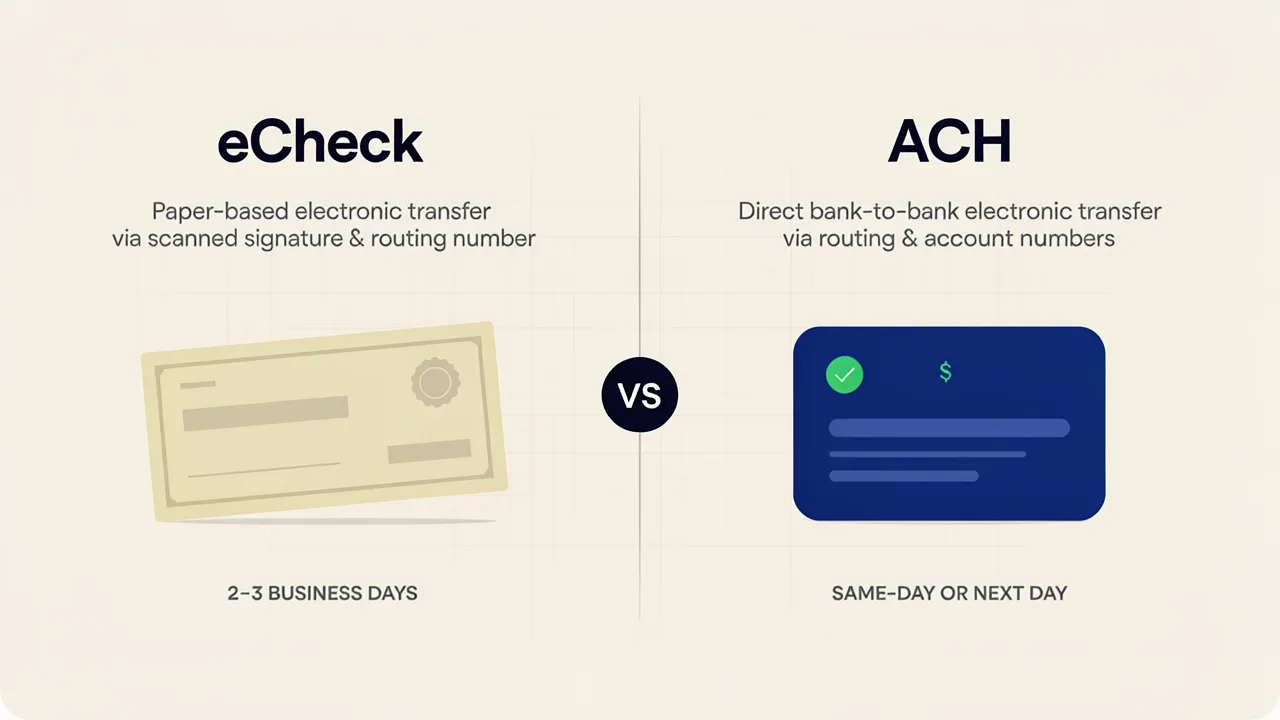
eCheck vs ACH: What’s the Difference and Which Should You Use?
If you’ve ever tried to set up bank payments for your business, you’ve probably hit this wall. One provider says “eCheck,” another says “ACH,” and you’re left wondering if you’re comparing two products or one product with two names.