What Is a Bank Wire Transfer? A Complete Guide to Fast and Secure Money Transfers ?
Learn what a bank wire transfer is, how it works, how much it costs, processing times, domestic vs international wire transfers, and when to use one.
What Is a Bank Wire Transfer?
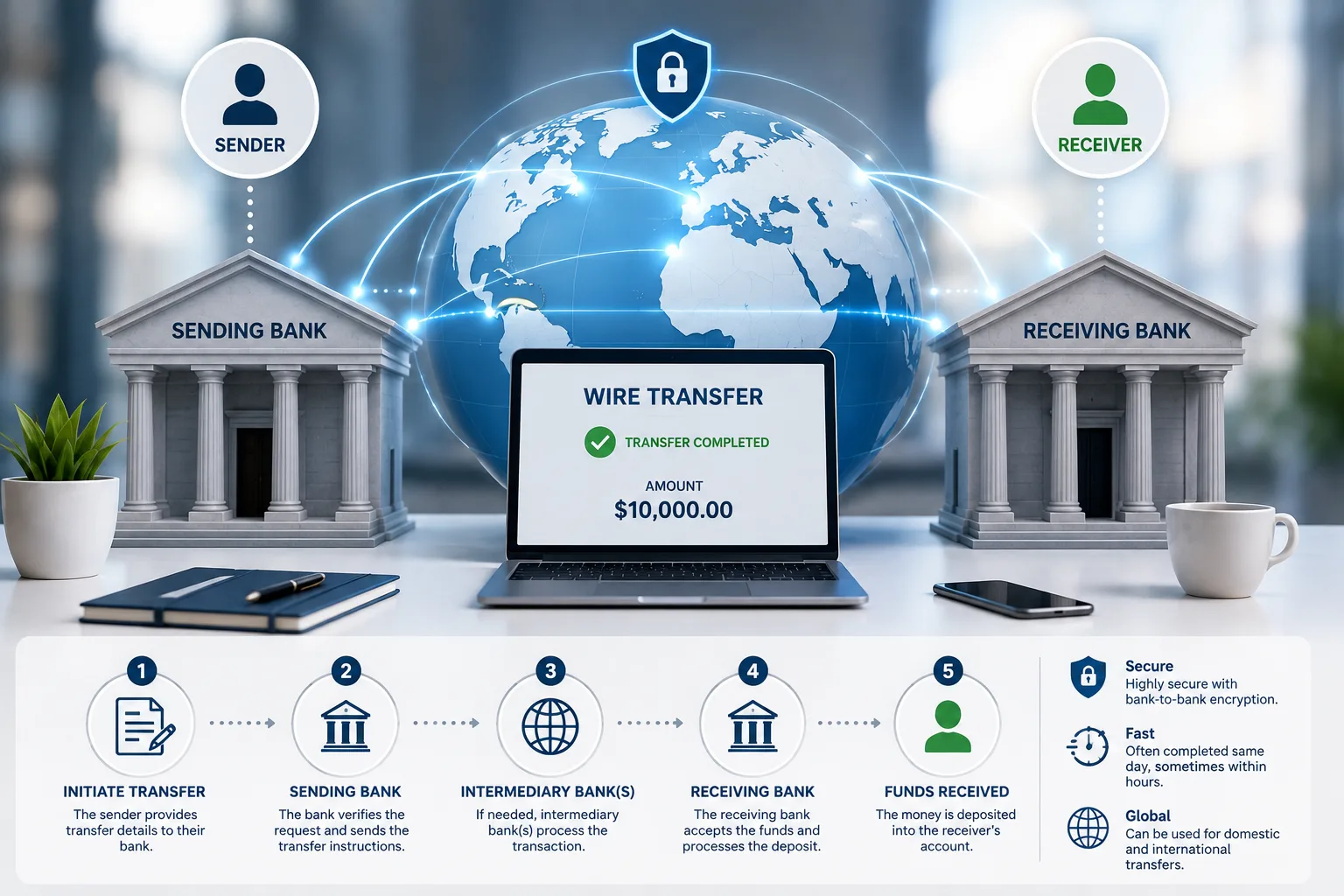
A bank wire transfer is an electronic method of sending money directly from one bank account to another. Unlike paper checks or cash payments, wire transfers move funds through secure banking networks, making them one of the fastest ways to transfer money.
Wire transfers are commonly used for:
Buying a home
Paying international suppliers
Business-to-business (B2B) payments
Sending large sums of money
Urgent personal transfers
Because the money is transferred through regulated financial institutions, wire transfers are considered highly secure and reliable. Most domestic wire transfers are completed on the same business day, while international transfers generally take one to five business days depending on the countries and banks involved.
How Does a Bank Wire Transfer Work?
A wire transfer involves two financial institutions communicating through secure payment networks.
The process typically works as follows:
The sender requests a wire transfer from their bank.
The sender provides the recipient's banking information.
The sending bank verifies the account and available funds.
The transfer is sent through a secure payment network.
The receiving bank credits the recipient's account.
The recipient is notified once funds arrive.
Unlike ACH payments, wire transfers are processed individually instead of in batches, allowing funds to arrive much faster.
Information Required for a Wire Transfer
Before initiating a wire transfer, you'll usually need:
Recipient's full name
Bank name
Bank account number
Routing number (for domestic transfers)
SWIFT/BIC code (for international transfers)
Recipient's address (sometimes required)
Transfer amount
Reason for payment (for some international transactions)
Providing accurate information is essential because correcting a completed wire transfer can be difficult.
How Long Does a Wire Transfer Take?
Processing time depends on several factors.
Domestic Transfers
Usually completed within a few hours
Often arrive the same business day
Transfers submitted after bank cut-off times may process the next business day
International Transfers
Typically take 1–5 business days
May take longer due to:
Time zone differences
Currency conversion
Compliance checks
Intermediary banks
Advantages of Bank Wire Transfers
Wire transfers offer several benefits:
Fast Processing
Funds often arrive the same day for domestic transfers.
High Security
Transfers move through regulated banking networks with multiple verification steps.
Ideal for Large Payments
Businesses and individuals frequently use wire transfers for high-value transactions.
Global Reach
International wire transfers allow payments to almost every country.
Reliable
Unlike checks, wire transfers don't require mailing or physical handling.
Disadvantages of Wire Transfers
Despite their advantages, wire transfers have some drawbacks.
Higher Fees
Wire transfers usually cost more than ACH transfers.
Difficult to Reverse
Once processed, recovering funds can be challenging if incorrect information was entered.
Limited Consumer Protection
Mistakes or fraud involving wire transfers can be harder to resolve than credit card disputes.
Banking Hours Matter
Many banks only process outgoing wire transfers during business hours.
Are Wire Transfers Safe?
Yes. Wire transfers are generally considered one of the safest payment methods because banks use encrypted networks and identity verification procedures.
However, users should:
Double-check recipient details
Verify payment requests independently
Beware of phishing emails
Confirm invoices before sending money
Never wire money to unknown individuals
Since completed wire transfers are often irreversible, accuracy is essential.
Common Uses for Bank Wire Transfers
Individuals and businesses use wire transfers for:
Real estate purchases
Business supplier payments
International trade
Tuition payments
Investment funding
Emergency family support
Legal settlements
Tips for Sending a Secure Wire Transfer
Before sending money:
Verify the recipient's identity.
Confirm bank account details.
Review transfer fees.
Understand currency conversion costs.
Keep your transaction receipt.
Send a small test payment if transferring to a new recipient.
Frequently Asked Questions
Can a wire transfer be cancelled?
Sometimes, but only if the transfer hasn't been completed. Once funds are settled, reversing the payment usually requires cooperation from the receiving bank.
What's the difference between a bank transfer and a wire transfer?
A bank transfer is a broad term covering multiple electronic payment methods, including ACH transfers and wire transfers. A wire transfer is specifically designed for fast, direct movement of funds.
Is a wire transfer faster than ACH?
Yes. Domestic wire transfers are typically completed the same business day, while ACH payments often take one to three business days.
Can I send a wire transfer online?
Many banks allow customers to initiate domestic and international wire transfers through online banking or mobile apps, although some may require additional identity verification.
Is there a maximum amount for a wire transfer?
Banks may set their own limits, but wire transfers are commonly used for large-value transactions and generally allow much higher limits than many other payment methods.
Final Thoughts
A bank wire transfer is one of the fastest and most dependable ways to move money, whether you're making a business payment, purchasing property, or sending funds internationally. While wire transfers typically cost more than ACH payments, they provide speed, security, and reliability when timing matters most.
Understanding how wire transfers work, their fees, and their advantages can help you choose the right payment method for your financial needs.
More from the blog

What Merchants Are Actually Saying About Using PayPal?
Ask ten store owners what they think of PayPal and you'll probably get ten different answers depending on whether they've ever had an account frozen.

Picking the Right Checkout Partner for Your Shopify Store
If you've ever set up a Shopify store, you know the moment: you get the theme looking nice, the products are loaded, the shipping rules are sorted, and then you hit the checkout settings and realize you have to make a decision you don't feel qualified to make.

How to Compare Payment Gateways Without Getting Overwhelmed
Every payment processor's marketing page claims to be the "best" option — which makes actual comparison shopping harder than it should be. Here's a simple framework to cut through the noise