How to Choose the Right Payment Processing Platform for Your Business
Learn how to choose the best payment processing platform for your business by comparing features, security, payment gateways, and online payment solutions.

Payment processing platforms are one of the most important decisions a company that deals with online payments has to make. Regardless of whether the business is a large, well-established enterprise, a small local company just beginning to accept online payments, or a subscription-based service, choosing the right payment processing platform is a crucial decision that should not be taken lightly.
The wide range of modern payment solutions, along with the additional services many providers offer beyond basic credit card processing, has made the selection process more complex than ever before.
If you are unfamiliar with modern online payment technology, you may want to begin with our Beginner's Guide to Modern Payment Technology.
What Is a Payment Processing Platform?
A payment processing platform is the technology that facilitates payments between merchants and their customers.
It is involved whenever a customer makes a purchase, whether online or in person.
Some payment processors provide only the essential functionality needed to complete transactions, while others offer a comprehensive suite of business tools.
A typical payment processing platform consists of several key components.
Software
The platform's software typically handles a wide range of functions, including:
Payment processing
Transaction management
Reporting
Analytics
Merchant Account
Most platforms include a merchant account that functions as the business's payment account for receiving customer funds.
Payment Gateway
Many payment processors also include a built-in payment gateway that enables secure payment processing between customers and merchants.
Security and Analytics
Additional features commonly include:
Fraud prevention tools
Reporting dashboards
Payment analytics
Transaction monitoring
What to Consider When Choosing a Payment Processing Platform
There is no single payment processor that is best for every business.
Each platform has its own strengths and limitations that should be carefully evaluated before making a decision.
Payment Methods
Modern customers expect flexibility when paying for products and services.
Ideally, your payment platform should support multiple payment options, including:
Credit cards
Debit cards
Digital wallets
Bank transfers
Buy Now, Pay Later (BNPL)
Recurring subscription payments
Offering more payment methods can improve customer satisfaction and reduce abandoned purchases.
Security
Security should always be a top priority when processing customer payments.
When comparing payment processing platforms, look for security features such as:
PCI DSS compliance
Data encryption
Tokenization
Fraud prevention tools
Risk monitoring
These features help protect both your business and your customers.
Integration
A payment platform should integrate smoothly with the tools your business already uses.
Look for compatibility with:
Your website
eCommerce platforms
Business software
Mobile applications
Accounting systems
POS terminals
Seamless integrations reduce manual work and improve operational efficiency.
Pricing
Pricing structures vary significantly between payment providers.
Besides standard transaction fees, pay attention to additional costs such as:
Transaction fees
Monthly subscription fees
Payment gateway fees
Chargeback fees
International transaction fees
Additional service charges
Understanding the complete pricing structure helps you avoid unexpected expenses.
The Importance of Payment Processing Software
Many modern payment processing platforms include advanced software designed to simplify business operations.
In addition to payment processing and refunds, these solutions often provide:
Payment reporting
Business analytics
Subscription management
Customer payment history
Financial insights
A robust payment processing system can help businesses streamline workflows, organize financial data, and improve operational efficiency.
It is also important to choose software that can scale as your business grows.
For more information, refer to our Business Payment Technology Guide.
Understanding Payment Gateways
Many people confuse payment processors with payment gateways.
Although they work together, they serve different purposes.
A payment processor facilitates the movement of funds between the customer and the business.
A payment gateway securely collects and encrypts payment information before transmitting it to the payment processor.
A reliable payment gateway plays a vital role in ensuring secure and successful transactions.
When comparing payment gateways, consider:
Ease of use
Security features
Mobile-friendly checkout
International payment support
Fraud detection capabilities
Choosing the Best Business Payment Solution
The ideal payment solution depends on your specific business model.
For example:
An online retail store has different payment needs than a subscription-based service.
A local retail business may require different features than an international eCommerce company.
Before selecting a payment processor, evaluate your business requirements and future growth plans.
Questions to Ask Before Choosing a Payment Processor
When comparing payment processing platforms, consider asking the following questions:
What payment methods are supported?
Are there any additional fees beyond the standard charges?
How quickly are funds deposited after each transaction?
What fraud prevention measures are included?
Is 24/7 customer support available?
Can the platform scale as my business grows?
Does it integrate easily with my existing business systems?
These questions can help you compare providers more effectively and identify the solution that best meets your needs.
Conclusion
Choosing the best payment processing platform requires careful evaluation of several important factors.
Payment methods, security, pricing, software features, integrations, scalability, and customer support all play a significant role in determining which platform is right for your business.
By considering both your current operational needs and your future growth plans, you can select a payment solution that delivers long-term value for both your business and your customers.
As online commerce continues to expand, having a secure, reliable, and scalable payment processing platform will remain an essential part of running a successful business.
More from the blog
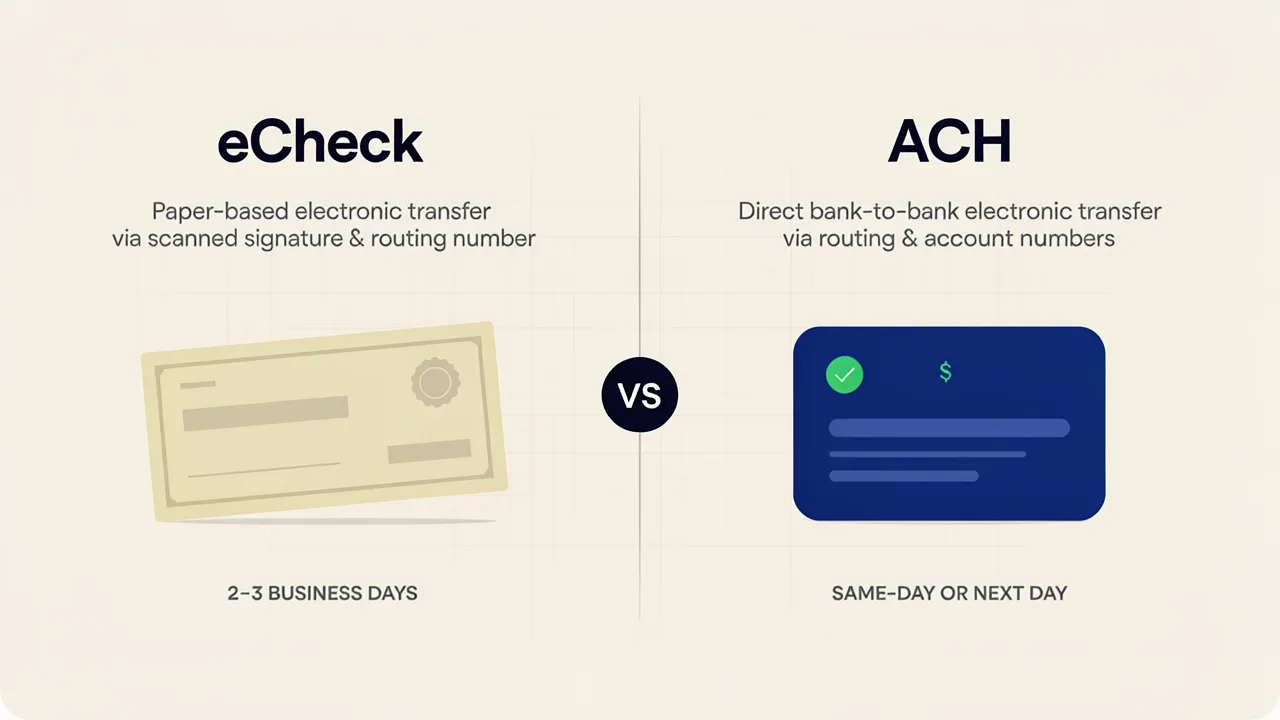
eCheck vs ACH: What’s the Difference and Which Should You Use?
If you’ve ever tried to set up bank payments for your business, you’ve probably hit this wall. One provider says “eCheck,” another says “ACH,” and you’re left wondering if you’re comparing two products or one product with two names.

How to Decline a Venmo Payment: What Happens Next?
Venmo doesn’t offer a simple way to “decline” incoming payments, but that doesn’t mean you’re powerless.

Square Fees in 2026: Here's What You Should Know
Square fees in 2026 are 2.6% + 15 cents in-person, 2.9% + 30 cents online, and 3.5% + 15 cents keyed-in. See the full breakdown and when Square may cost more than alternatives.